U-cup Seal Material Selection and Performance Range in Hydraulic Systems
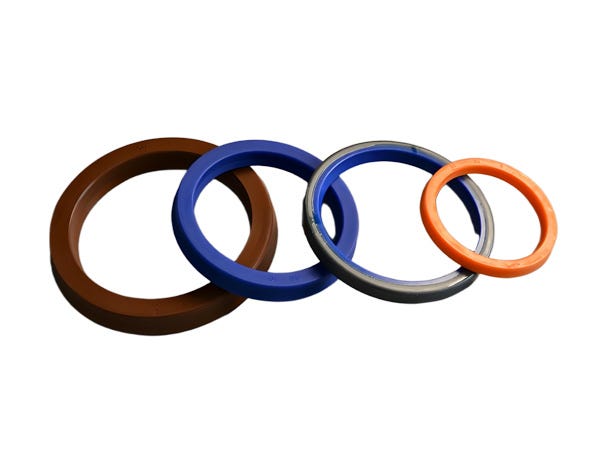
In the world of hydraulic and mechanical sealing, U-cup seal is a workhorse design. Their cross-section resembles the letter “U,” which gives them the ability to flex under pressure and create a tight sealing lip against the mating surface. This self-energizing property makes them highly reliable in reciprocating motion, heavy-load environments, and systems where downtime is costly.
Compared with traditional O-rings, which rely on pre-compression and system pressure alone, U-cup seals provide more stability under high pressure and dynamic movement. That explains why they are frequently used in hydraulic cylinders, pumps, actuators, and machinery that requires long service life and minimal leakage risk.
Materials and Performance Range
The choice of material directly determines the seal’s working range. Some of the most common options include:
Polyurethane (PU): Excellent wear resistance and elasticity, widely used in excavators, loaders, and general construction equipment.
Fluorocarbon (FKM): Designed for high temperatures and aggressive fluids, often selected in petrochemical plants and metallurgy.
Depending on design, PU U-cup seals can withstand 25–40 MPa in standard hydraulic systems, while reinforced versions perform well in even higher ranges. For distributors and wholesalers, having clarity on these limits helps in guiding customers quickly to the right solution.
Application Sectors
The versatility of U-cup seals makes them indispensable across multiple industries:
Hydraulic systems: Pumps, cylinders, and valves in industrial machinery.
Construction equipment: Excavators, loaders, and road machinery.
Robotics and automation: Actuators and linear drives requiring precision sealing.
Energy sector: Wind turbines, water treatment pumps, and power plant equipment.
Transportation: Rail vehicles, heavy trucks, and aviation support systems.
End-users in these fields demand seals that can endure long duty cycles and prevent fluid leakage, as failures often lead to unplanned shutdowns and financial losses.
Concerns from Distributors and Wholesalers
When working with customers, certain questions come up repeatedly:
“Can you provide non-standard sizes?”
Many end-users require custom profiles for older equipment or unique designs. A manufacturer with in-house engineering and testing capabilities becomes a preferred partner.
“Is stock available for urgent needs?”
Distributors often serve maintenance contractors who cannot afford downtime. Ready-to-ship stock of common sizes is a decisive factor in supplier selection.
“What about lifecycle and maintenance costs?”
Higher quality seals extend replacement intervals. This lowers total cost of ownership for end-users and builds long-term loyalty for wholesalers who supply reliable brands.
The Role of NQKSF in the Market
This is where NQKSF has built its reputation. With over 30 years of experience, the company combines real manufacturing facilities with a global supply chain that reaches more than 80 countries. Its catalog covers a full range of standard U-cup seals and other sealing elements, while the customized service program supports projects from material selection and structural design to production and testing.
For distributors, this means two things:
Faster response times with “standard parts in stock, ready to ship,” ensuring clients avoid costly downtime.
Added technical value, as NQKSF engineers collaborate to optimize sealing systems, reduce failure rates, and improve equipment reliability.
Beyond production, NQKSF has earned recognition as a provincial innovation center, specialized and high-tech enterprise, and a leading player in local industrial clusters. These credentials reflect not only capacity but also a commitment to technology-driven sealing solutions.
U-cup seals may be a small component, but they serve as a critical safeguard in hydraulic and mechanical systems. For distributors and wholesalers, the ability to source high-quality, readily available seals is a direct business advantage.


Comments
Post a Comment