How do Various Oil Seal Materials Perform in Heavy Truck Engines Transmissions and Axles
If you’ve ever worked around heavy-duty trucks, you know the smallest components often cause the biggest headaches. Oil seals, for example, look like simple rings of rubber and metal — but once they fail, you’ll see the real cost. Leaks, bearing wear, dust contamination, gearbox noise — it all starts there. And in the trucking business, downtime is money.
A heavy truck doesn’t live an easy life. Long distances, constant vibration, wide temperature swings, and muddy road conditions are part of its daily routine. The seals on such vehicles must deal with hot oil on one side, road dust and water on the other. The environment leaves no margin for weak materials or poor design.
Material and Structural Choices
Different positions in the truck have different demands. The crankshaft area, for instance, works at high temperature and pressure, while wheel-end seals must resist mud and road debris.
For these, the common materials are NBR, FKM, HNBR, and PTFE:
NBR (Nitrile Rubber) is affordable and reliable under standard oil and temperature ranges.
FKM (Fluoroelastomer) is favored for engines and transmissions that run hot and deal with aggressive oils.
HNBR (Hydrogenated Nitrile) provides a strong balance — good wear resistance with flexibility under pressure.
PTFE (Polytetrafluoroethylene) is often used where extreme durability or low friction is required, especially on rotating shafts that can’t tolerate high drag.
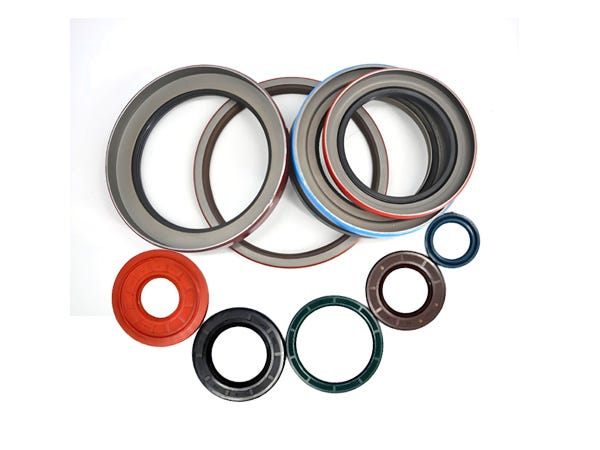
Many people think “premium material means longer life.” Not always. The seal’s lip geometry, spring tension, and surface finish matter just as much. I’ve seen inexpensive seals outlast so-called “high-end” ones just because they were installed correctly or matched to the right shaft hardness.
A few years ago, our team worked with a logistics fleet that kept replacing wheel-end seals every six months. Instead of changing suppliers, we adjusted the lip design and used a hybrid HNBR compound with better flexibility. The result? Triple the service life, same cost. That’s what real matching means — not just using expensive rubber, but engineering for the actual working environment.
Installation and Maintenance — Lessons from the Field
Oil seals aren’t plug-and-play parts. Proper installation makes all the difference. The shaft must be smooth, free of burrs, and the seal lip lubricated before pressing in. One of the most common mistakes? Hammering the seal in place. It seems faster, but the lip distorts, and you’ll see micro-leaks before the truck even hits the road. Always press it evenly — use an installer if possible.
Maintenance-wise, seals rarely fail suddenly. They age slowly. By the time oil stains appear on the hub, it’s usually past the optimal replacement window. A good rule of thumb: inspect heavy truck wheel seals every one or two oil changes. If you find hardened grease or small cracks on the lip, don’t wait — replace them before a bigger failure follows.
NQKSF’s Role and Technical Expertise
At NQKSF, we’ve been involved in sealing solutions for over three decades, working closely with manufacturers and service centers. We operate a fully equipped production facility, from rubber compounding and mold development to full-scale performance testing.
For customers needing standard parts, our warehouse stocks over ten thousand specifications — O-rings, oil seals, and other sealing components. This allows for immediate shipment when emergency replacements are required.
For more specialized requests, we provide custom engineering support — from selecting the right material to designing and validating the product under real working conditions. Our goal isn’t just to sell a seal; it’s to enhance the entire sealing system. By optimizing friction, contact pressure, and compatibility with lubricants, we help customers reduce maintenance intervals and extend uptime.
What Dealers and Fleet Buyers Care About
When talking to distributors or B2B clients, the same three questions always come up:
Can I find all the models in one place?
Dealers hate chasing different suppliers for small variations in size. NQKSF keeps a wide catalog so customers can order everything together.
Is delivery reliable?
We understand downtime costs money. That’s why our logistics system ensures fast turnaround — standard parts are always ready to go.
How about product consistency?
The worst scenario for resellers is when one batch works well and the next one doesn’t. Every batch at NQKSF undergoes uniform inspection and traceable production control, ensuring stability across markets.
With exports to over 80 countries, NQKSF has built long-term cooperation with both OEM factories and aftermarket service providers. The company has been recognized as a Provincial Technology Innovation Center, a High-Tech Enterprise, and a Specialized and Innovative Manufacturer, standing out as a leader in the regional sealing industry cluster.
Heavy truck oil seals may be small, but they carry big responsibility. They protect the system’s heart — keeping oil where it should be and dirt where it shouldn’t. When a vehicle is expected to run millions of kilometers without fail, there’s no room for weak sealing.


Comments
Post a Comment