How To Choose The Right Oil Seal Material for Engines
In modern engines, oil seals are small components with a large responsibility. They prevent lubricants from leaking out of the crankcase or camshaft housing while keeping dust, water, and combustion residues from entering. As engines become more powerful, compact, and efficient, the choice of oil seal material has become a decisive factor in ensuring long-term reliability.
The Demands of Engine Environments
Engine oil seals face a combination of challenges rarely found in other applications:
High temperature: Continuous exposure to 120–150°C, with peaks above 200°C near turbochargers or exhaust-side crankshafts.
High speed: Crankshafts and camshafts rotate at thousands of revolutions per minute, creating friction and heat at the sealing lip.
Chemical exposure: Seals must resist degradation from engine oils, additives, and occasional contact with fuel vapors.
Pressure fluctuations: Rapid changes in crankcase pressure can stress the sealing lip.
If the wrong material is chosen, seals may harden, crack, or lose elasticity, leading to oil leakage, increased maintenance costs, and even engine failure.
Common Materials for Engine Oil Seals
NBR (Nitrile Rubber)
Strengths: Good oil resistance, cost-effective, widely available.
Limitations: Limited heat resistance; tends to harden above 120°C.
Typical use: Older or low-load engines.
FKM (Fluoroelastomer)
Strengths: Excellent resistance to heat (up to 200°C), oil, and fuel vapors.
Limitations: Higher cost compared to NBR.
Typical use: Crankshaft and camshaft seals in modern passenger cars and heavy-duty engines.
PTFE (Polytetrafluoroethylene)
Strengths: Very low friction, outstanding wear resistance, chemically inert.
Limitations: Requires precise installation; less elastic than rubber.
Typical use: High-speed shafts, turbocharged engines, and long-life applications.
VMQ (Silicone Rubber)
Strengths: Wide temperature range, good flexibility in cold climates.
Limitations: Weaker oil resistance compared to FKM.
Typical use: Auxiliary seals in engines exposed to large temperature swings.
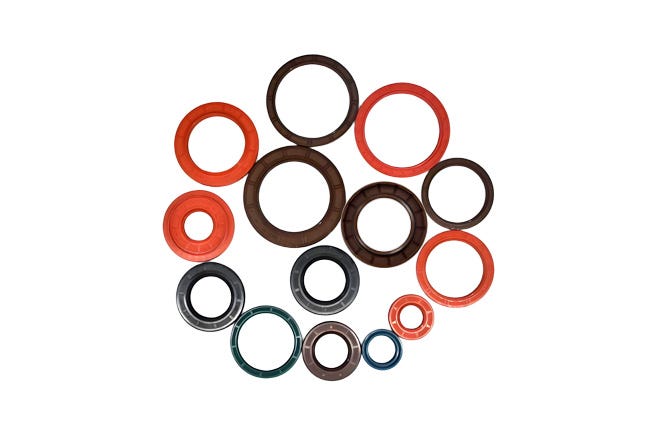
Composite Designs
Strengths: Combine metal casings with advanced elastomers or PTFE lips.
Typical use: Heavy-duty engines requiring both structural strength and long sealing life.
Installation and Maintenance Considerations
Even the best material can fail if installation is careless. Industry experts emphasize:
Surface finish: The shaft must be smooth and free of scratches.
Alignment: Misalignment during installation leads to uneven wear.
Lubrication: A thin layer of grease on the lip reduces initial friction.
Inspection: Regular checks help detect hardening or leakage before major damage occurs.
Industry Outlook
As engines evolve toward higher efficiency and stricter emission standards, oil seals must adapt. Trends include:
Low-friction materials to reduce energy loss.
Eco-friendly compounds that comply with environmental regulations.
Smart seals with embedded sensors for predictive maintenance.
NQKSF Services and Company Highlights
In this demanding environment, NQKSF provides comprehensive support to distributors, OEMs, and end-users:
Standard parts, ready to ship: Over ten thousand specifications of O-rings and oil seals in stock, ensuring rapid response to urgent needs.
Customized solutions: From material selection and structural design to production and testing, seals tailored to specific engine conditions.
Technical empowerment: With more than 30 years of experience, NQKSF helps optimize sealing systems, reduce maintenance costs, and improve reliability.
The company also stands out with its modern manufacturing facilities, leadership in the sealing industry, complete range of models in stock, exports to more than 80 countries, recognition as a global brand, provincial technology innovation center, specialized and innovative enterprise, high-tech enterprise, and leadership in industrial clusters.
Choosing the right oil seal material for engines is not about a single formula. It requires understanding the operating conditions, matching them with the right material, and relying on a partner that combines technical expertise with reliable service.
FAQ
Q: Which material do customers ask about most often? A: Many ask whether NBR is still sufficient. For modern engines, FKM or PTFE is usually recommended.
Q: How can distributors strengthen customer loyalty? A: By keeping common sizes in stock and offering technical advice on material selection.
Q: How do you balance cost and service life? A: By showing the cost of downtime. A premium seal may cost more upfront but saves money by preventing failures.


Comments
Post a Comment