How do Evolving System Requirements Affect Oil Seal Material Decisions?
Selecting oil seal materials should be based on the working medium, long‑term operating temperature, and application environment, rather than cost or general applicability. Choosing the right material ensures stable sealing throughout the design life. Choosing the wrong one can lead to early failure, even if the structural design is sound.
Why Must Oil Seal Materials Be Chosen According to Operating Conditions
From a sealing‑mechanism perspective, the lip of an oil seal must form a stable oil film on the shaft surface. The material directly determines three critical factors:
· Whether it will be attacked or swollen by the medium
· Whether its elasticity will degrade under long‑term temperature exposure
· How well the lip resists wear under friction
According to data from multiple international seal manufacturers (including reports on sealing components used in automotive drivetrains), more than half of oil seal failures are related to material aging or medium incompatibility, rather than dimensional or installation issues. This is why material selection is treated as a top priority in oil seal design.
Comparing Common Oil Seal Materials: Which One Should You Choose
In practical applications, the most frequently discussed materials are NBR and fFKM.
NBR vs FKM: Which Is More Suitable
From a performance standpoint:
· NBR offers good compatibility with mineral oils and lubricants. It is cost‑effective and stable within moderate temperature ranges. However, it ages more quickly in high‑temperature environments or in oils containing additives.
· FKM maintains performance more effectively at high temperatures and provides better stability in fuels, synthetic oils, and certain chemical media. It is more suitable for long‑duration systems, though it comes with higher material and processing costs.
Industry data from major automotive OEMs and powertrain suppliers shows that FKM is used far more frequently than nitrile rubber in engines, hybrid systems, and electric drive shaft seals. Meanwhile, nitrile rubber remains the mainstream choice in gearboxes, motors, and agricultural machinery.
The conclusion is not about which material is “better,” but which one is more appropriate for the specific operating conditions.
How to Select Materials for Different Application Scenarios
Breaking the selection down by application makes the decision clearer.
· General Industrial Equipment
Medium: Lubricating oil
Temperature: Low to moderate, with minimal fluctuation
Recommended material: NBR
In this scenario, material stability and cost efficiency matter most, and over‑specification is unnecessary.
· Automotive Drivetrain and Engine Systems
Medium: Engine oil, transmission fluid
Temperature: Long‑term high temperature
Recommended material: FKM or ACM
Industry reports on drivetrain sealing components emphasize resistance to thermal aging rather than short‑term cost.
· New‑Energy Drive Systems
Medium: Synthetic lubricants, cooling fluids
Temperature: Localized temperature rise
Recommended material: Modified FKM or specialized rubber formulations
New‑energy systems require higher material stability. A single material parameter is no longer sufficient; supplier validation data is often necessary.
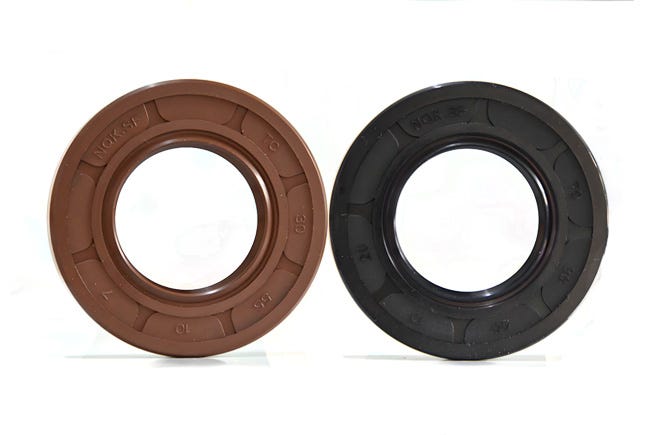
From these examples, it is clear that oil seal material selection must be based on long‑term operating conditions, not short‑term performance. This also explains why many failure analyses show oil seals performing normally at first, only to develop hardening, leakage, or lip wear after a period of operation.


Comments
Post a Comment