How do Skeleton Oil Seals for Robot Shaft Systems Avoid Loss of Lip Sealing Force in Cold Conditions?
In low-temperature applications such as polar research robots and cold-region industrial equipment, the sealing performance of skeleton oil seals (radial shaft seal) is subjected to severe challenges. Engineers frequently observe that seals performing reliably at ambient temperature begin to exhibit oil leakage and abnormal wear when operating below –30 °C.
The underlying cause is not assembly error, but the loss of effective interference compensation at low temperature.
The Triple Impact of Low Temperature on Lip Interference
Material Stiffening: Low-Temperature Rubber Hardening
Elastomer modulus increases significantly at low temperature
Reduced lip compliance weakens conformity to the shaft surface
Typical case: leakage in a polar robot joint seal increased markedly at –40 °C
Rubber hardening directly limits the lip’s ability to maintain stable contact pressure.
Thermal Expansion Mismatch: Competition Between Materials
Different thermal expansion coefficients of elastomer, metal case, and shaft
Rapid temperature drop alters interface stress distribution
Test results show that at –25 °C, effective interference may decrease by approximately 0.1 mm
This dimensional mismatch directly reduces sealing pressure under cold conditions.
Lubrication Degradation: Oil Film Formation Failure
Lubricant viscosity increases sharply at low temperature
Start–stop operation shifts the contact into boundary friction
Industry observations indicate that start-up wear at –30 °C can be several times higher than at room temperature
Poor lubrication accelerates lip wear and destabilizes sealing performance.
The Golden Rules of Interference Design
Balance for Standard Operating Conditions
Typical interference range: 0.35–0.55 mm
Optimized balance between sealing capability and service life
This range is suitable for most conventional applications when temperature effects are limited.
Strategies for Special Operating Conditions
Interference up to 0.8 mm may be considered under high-pressure conditions
Dynamic applications require interference compensation, not static enlargement
Common Design Pitfalls
Excessive interference increases friction torque and start-up resistance
Documented cases show that over-interference can cause torque to exceed system limits, especially at low temperature
Interference should be validated through simulation and testing, not increased empirically.
Material Selection: Three Key Directions
FVMQ: Flexibility in Extreme Cold
Maintains elasticity down to approximately –60 °C
Good balance between oil resistance and flexibility
Typical application: polar robot joint sealing
Low-Temperature Formulated FKM: Versatility for Moderate Cold
Improved aging resistance and elastic recovery
Suitable for low- to mid-temperature industrial sealing
Commonly used in cold-region industrial equipment
HNBR: Strength Under Load
Balanced mechanical strength and low-temperature elasticity
Enhanced durability under impact and load fluctuations
Successfully applied in cold-region construction machinery
Material selection should focus on elastic recovery at low temperature, not nominal temperature ratings alone.
Spring System: The Art of Compensation
Core Compensation Function
Maintains contact force when rubber stiffness increases
Optimized spring force–displacement curve
Practical designs demonstrate effective interference retention even below –40 °C
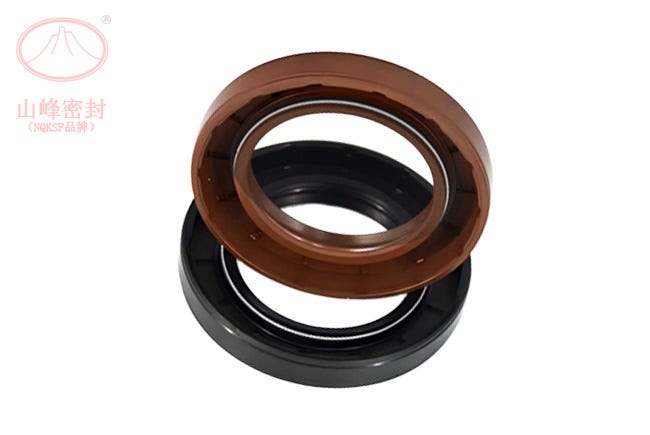
Structural Innovations
Use of radial garter springs to stabilize contact pressure
Improved pressure distribution along the sealing lip
Emerging concepts include adaptive spring compensation mechanisms
The spring becomes the dominant compensating element in extreme cold.
Structural Design Intelligence
Enhancing Compliance
Reduced lip cross-section
Optimized elastic arm length
Measured improvements in lip flexibility are significant compared with conventional designs
Dynamic Adaptation
Optimized contact angle to reduce stress concentration
Improved response to shaft micro-movement
Advanced designs incorporate self-adaptive lip geometries
System-Level Solutions
Surface Engineering
Shaft roughness control for low-temperature lubrication
Application of micro-textures to support oil retention
Measured friction reduction compared with smooth surfaces
Thermal Matching and Tolerance Design
Coordinated thermal expansion of multi-material components
Compensation for assembly tolerances under cold conditions
Integrated system design significantly improves temperature adaptability
Conclusion: From Passive Endurance to Active Adaptation
The core shift in low-temperature sealing design lies in:
Moving from static interference to dynamic compensation
Transitioning from single-component optimization to system-level coordination
Replacing trial-and-error with simulation-driven design
As one experienced sealing engineer noted:
“At –40 °C, a seal must learn to ‘breathe’.”
This concept may well define the future direction of low-temperature sealing technology.


Comments
Post a Comment