How do You Determine O Ring Dimensions Using Standard Tables?
O rings are among the most common and fundamental sealing components in the industry. Despite their small size, choosing the right o ring can ensure stable equipment operation, while choosing the wrong one may lead to leakage, wear, or even equipment failure. This overview explains the major size standards, key dimensional parameters, common specifications, and material‑selection guidelines to help you make informed decisions.

Common O Ring Size Standards
Several standardized systems are widely used across industrial applications.
ISO 3601 (International Standard)
Developed by the International Organization for Standardization
Suitable for a wide range of industrial sealing applications
Defines standard inner diameter (ID) and cross‑section (CS) dimensions
Commonly used in hydraulic, pneumatic, automotive, and general machinery systems
AS568A (U.S. Standard)
Also known as MIL‑S‑8805
Widely used in aerospace, defense, and high‑precision engineering
Features a clear numbering system for quick selection
Common in imported equipment and high‑accuracy applications
Key Dimensional Parameters
Understanding two core parameters helps determine whether an o ring fits the application.

The outer diameter (OD) can be calculated as: OD = ID + 2 × CS This value is for reference only.
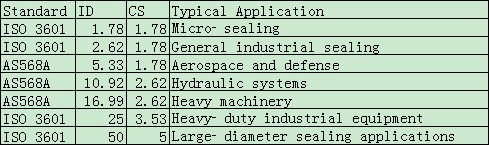
Common O Ring Size Examples (mm)
Common O Ring Materials and Their Applications
MaterialCharacteristicsSuitable Environment

Selection and Installation Guidelines
Size matching: Verify groove dimensions before selecting an o ring to ensure proper compression.
Material compatibility: Choose materials based on the working medium such as oil, water, gas, or chemicals.
Installation practices: Avoid excessive stretching or surface damage. Use lubricant when necessary.
Pressure and temperature considerations: High‑pressure or high‑temperature applications require specialized materials and proper compression‑rate checks.
O-rings may be small, but the standards behind them are extensive. Understanding common sizes and material characteristics can significantly improve sealing reliability. If you are unsure about selection, feel free to save this guide or share your application details — I can help you create a customized selection chart or installation checklist.


Comments
Post a Comment