What Distinguishes Oil Seals From Other Types of Seals?
Many people feel confused the first time they hear the terms “oil seal” and “seal,” and it is true that these terms are often mixed up in real‑world conversations. In fact, the relationship between them is simple: one is a broad category, and the other is a specific subset.
A sealing component is a general term, while an oil seal is just one type within that category. It is similar to the relationship between “fruit” and “apple” — an apple is always a fruit, but fruit is not limited to apples.
If we summarize the difference in one sentence: sealing components are used across almost all types of applications, while oil seals focus on one job — sealing rotating shafts and keeping oil where it belongs.
Structural Differences
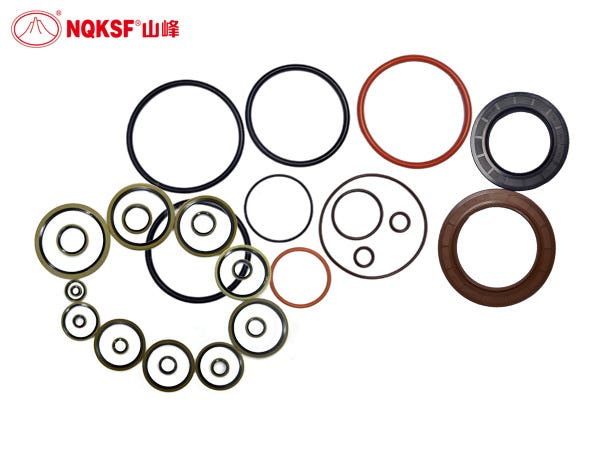
Most common sealing components — such as O‑rings, X‑rings, and gaskets — are structurally simple. They are usually made of rubber or composite materials and work by being compressed inside a groove. This makes them ideal for static sealing and some low‑speed, short‑stroke reciprocating motion.
Oil seals, however, are built very differently. They contain a metal case for rigidity, a spring to maintain constant radial force, and a sealing lip that stays in contact with the rotating shaft. Oil seals do not rely on compression to seal; instead, the lip continuously wipes and retains oil during rotation, functioning almost like a controlled oil‑scraping mechanism.
Differences in Working Conditions
Because their structures differ, their working principles and application ranges are also completely different.
General sealing components can be used on flanges, end covers, hydraulic cylinders, pneumatic cylinders, and many other static or low‑speed positions.
Oil seals, on the other hand, are almost exclusively used on rotating shafts — often under medium‑ to high‑speed conditions. Examples include engine crankshafts, motor shafts, gearboxes, and reducers. Asking an O‑ring to handle thousands of RPM is essentially guaranteeing a leak.
Application Scenarios
Sealing components are everywhere — from industrial machinery to everyday products. Oil seals are less “universal,” but in the places where they are required, they are irreplaceable. Their core mission is simple: keep lubricating oil inside and keep dust and moisture out.
Because of this, the two cannot replace each other. Using an oil seal in a static sealing position is unnecessary and costly, while using a simple sealing ring on a rotating shaft is a recipe for premature leakage.
Why This Distinction Matters
If you work in manufacturing, foreign trade, or equipment maintenance, understanding this difference is essential. Customers often use “seal,” “sealing ring,” and “oil seal” interchangeably. You must determine what they actually need based on the working conditions — whether the shaft rotates, what medium is being sealed, and what structure is appropriate. This is also why many factories list oil seals as a separate product category rather than grouping them under general sealing components.
A sealing component is a broad category.
An oil seal is the specific type designed for rotating‑shaft oil sealing.
They differ in structure, working conditions, and application — and they are not interchangeable.


Comments
Post a Comment