How Much Interference Should an Oil Seal Lip Have on the Shaft
To be honest, I have been asked about oil seal interference fit more times than I can count. Whenever someone asks what value is correct, my first question is always: what are the operating conditions of your equipment? This parameter is not a fixed number. It is influenced by shaft precision, speed, temperature, and the elasticity of the material.
Let me put the conclusion up front: there is no single interference fit that works for every machine. But most engineers have a general range in mind.
For the oil seals commonly used in factories, such as nitrile rubber and fluorocarbon rubber, the interference between the lip and the shaft usually falls between 0.2 and 0.5 millimeters. This range is not random. It is based on years of practical experience showing that this interval is generally stable and reliable.
Why not make it tighter? Because excessive pressure increases friction and heat, causing the lip to age and fail much faster. You may think the seal is tighter, but it actually burns out sooner. Why not make it looser? That is even worse. If the lip cannot maintain proper contact with the shaft, the oil film cannot form, and leakage becomes inevitable.
From my own field experience:
For high speed equipment, such as fast rotating motors, I usually choose a smaller interference, around 0.2 to 0.35 millimeters. Too much pressure and the lip will not survive.
For low speed or heavy load machinery, such as construction or agricultural equipment, the shaft surface is often rougher. In these cases, a larger interference is more common, and values like 0.4 to 0.6 millimeters are not unusual.
For shafts with very fine surface finishes, around Ra 0.2, a smaller interference actually performs better.
For high temperature applications, fluorocarbon rubber becomes harder, so the interference should not be too large. Otherwise, thermal expansion will make the lip pressure uneven.
Once you look at these scenarios, it becomes clear why the numbers you see online vary so much. It is not about right or wrong. It is simply that everyone is dealing with different operating conditions.
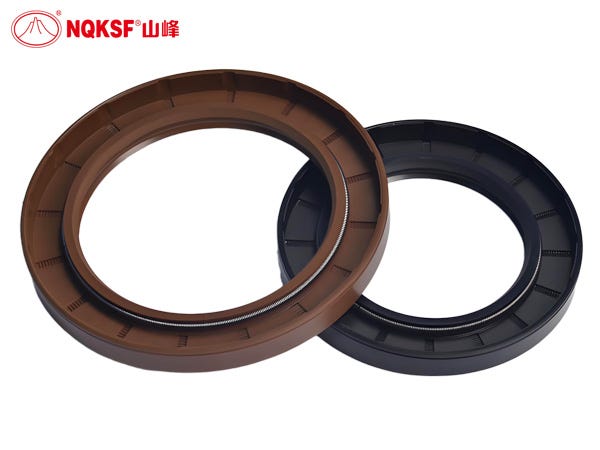
If you want a commonly accepted answer, it is this: 0.2 to 0.5 millimeters is a stable and widely used range. The rest is fine tuning based on the actual equipment.
Many things in this industry are like that. You do not learn them from a book. You learn them on the job.


Comments
Post a Comment